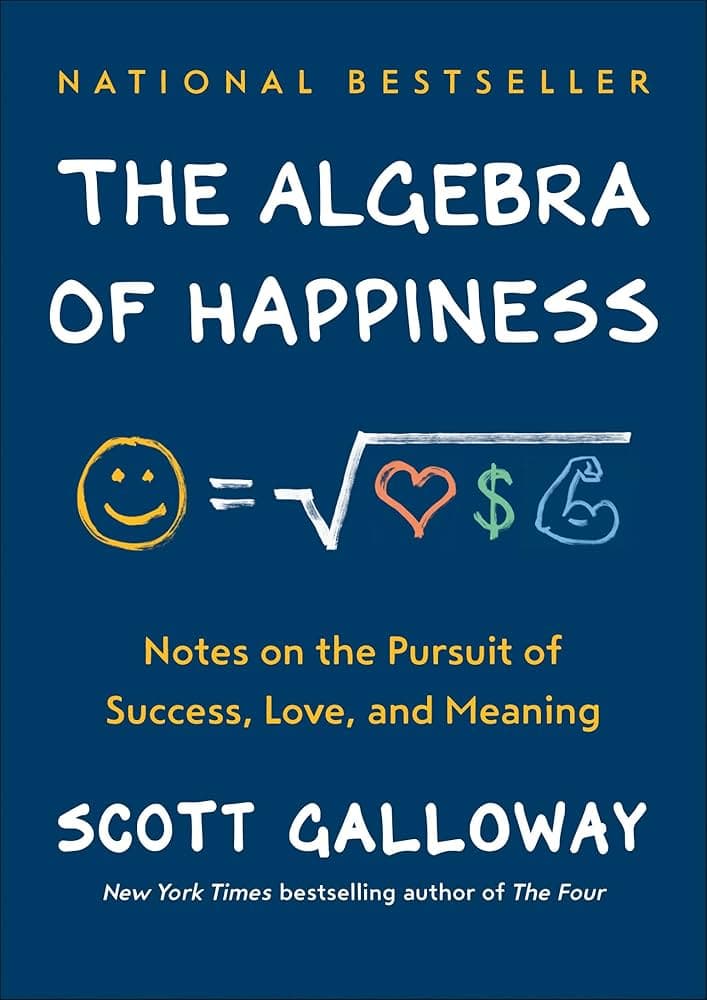
The Algebra of Happiness — Scott Galloway
Impressions
The book is not a research paper. It is a collection of advice from someone who has made money, lost a marriage, built companies, and buried a parent. That is actually its strength. Galloway earns the right to make blunt claims because he is drawing on lived experience, not just surveying the literature.
The strongest parts are the ones where he refuses to be comforting. The section on economic security is honest in a way self-help books usually are not. He does not pretend money is unimportant. He says the opposite: financial stress is corrosive to everything else you care about, so take it seriously early.
I found the section on relationships with aging parents the most affecting. The math he does on how many hours you have left with a dying parent is the kind of arithmetic most people avoid because it is true and it requires action. The weakness is that some chapters feel like polished tweets: sharp observations that do not go deep enough to move you beyond the observation itself. For a book this personal, it can also feel oddly armored at times, like Galloway is sharing emotion at one remove.
Who Should Read It?
- People in their 20s or 30s who are sacrificing everything for career and have not stopped to ask whether the tradeoff is worth it.
- Anyone drifting through life without economic ambition who needs someone to say plainly that financial security is not a shallow goal.
- People who have lost a parent or are watching one age and want language for what that demands of them.
- Anyone who has built their entire identity around their job and has never questioned whether that is a good idea.
How the Book Changed Me
I started doing the hours-left math with people I love. Galloway's point that you have already spent most of the time you will ever have with your parents, if you have moved out and live in a different city, is not comfortable. But calculating it forces the question: what are you actually doing with the time that remains?
I also stopped treating financial ambition as something I had to apologize for. Before reading this, I half-believed the cultural message that caring too much about money was somehow spiritually suspect. Galloway makes the opposite case clearly: economic insecurity is bad for your relationships, your health, and your judgment. Pursuing financial stability is not greed. It is a prerequisite for the other things you want.
My Top 3 Quotes
"The most important decision you'll make is not where you go to school or what company you join. It's who you decide to partner with."
The partner decision is irreversible in a way that career decisions usually are not. This quote treats it with the weight it deserves instead of treating it as a soft personal matter separate from "serious" decisions.
"Unhappy people focus on what's happening to them. Happy people focus on what's happening."
The clearest statement in the book on where attention goes. Resentment is attention turned inward. Presence is attention turned outward. The direction is the difference.
"You are not special. The sooner you realize this, the sooner you can get to work building something that actually is."
I find this clarifying rather than deflating. Exceptionalism has to be built, not assumed. The people who wait to be recognized for inherent greatness are wasting time that could be spent becoming genuinely good at something.
Summary + Notes
On Success and What It Actually Costs
Success Is Not the Goal. It Is the Vehicle.
Galloway's frame from the start: success is worth pursuing, but only as a means to something else. The people who make success the terminal goal end up wealthy, accomplished, and unhappy, because they optimized for the wrong thing.
The book is structured as advice to a younger version of himself, or to anyone who is still early enough in their life to change the trajectory.
Get to a Market Where You Can Win
One of Galloway's most pragmatic claims: where you live matters. Cities with concentrated economic opportunity give you more chances to compound skill into advancement. The person with moderate talent in a high-opportunity environment will outperform the exceptional person in the wrong one.
The corollary: find a place where you can be genuinely good, not just average. Average in a crowded field produces average outcomes. Excellent in a niche you own produces leverage.
Your 20s Are for Sacrifice
The advice is deliberate and unfashionable: work harder than feels reasonable in your 20s. Build economic security while your obligations are lowest and your recovery time from failure is highest. This is the window. It does not stay open.
This is not an argument for workaholism as a lifestyle. It is an argument for timing. The person who invests heavily in career early can shift attention to relationships and family later without the financial anxiety that makes that shift so difficult.
On Relationships
The One Asymmetric Asset
Galloway is direct: relationships are the one investment that consistently produces returns that compound over time. Career achievements plateau. Financial assets can vanish. Health declines. Relationships, sustained over decades, become the primary source of meaning for most people by the time they are old enough to look back honestly.
The research he cites is not novel. The Harvard Study of Adult Development has tracked men for over 80 years and reaches the same conclusion: close relationships are the strongest predictor of wellbeing in old age. Not wealth, not fame, not career success. Relationships.
"The most predictive variable for your happiness is the depth and breadth of your relationships."
Partner Selection Is the Most Consequential Decision
Galloway treats partner selection with more seriousness than most professional advice does. He argues that who you choose to build a life with shapes almost every other outcome: financial, emotional, psychological, and social.
The attributes he looks for: someone who is genuinely kind, not just kind to you. Someone whose character is consistent across contexts. Someone who makes hard things slightly less hard, not someone who adds to the difficulty.
He also makes the case, plainly, for staying attractive in a long-term partnership. Not in a shallow sense, but in the sense of continuing to invest in yourself, remaining interesting, staying physically and mentally present. Relationships decay when people stop trying.
The Hours Left With Your Parents
This is the section I found most confronting.
If you moved out at 18 and your parents live to 80, and you visit for a few weeks each year, you have already spent the majority of the time you will ever have with them. The hours remaining are finite and calculable. Most people do not calculate them because calculation requires action.
Galloway's point is not to produce guilt. It is to produce urgency. The time is there. You choose what to do with it.
On Happiness
Happiness Is Not Found in Achievement
The most consistent finding in happiness research is that achievement produces a brief spike and then a return to baseline. The promotion, the launch, the exit: they feel significant in anticipation and for a short time after. Then they stop mattering.
Galloway does not conclude from this that achievement is pointless. He concludes that it is a necessary but insufficient condition. You need enough success to eliminate financial stress and build something you are proud of. Beyond that, the returns diminish sharply and the things that actually sustain wellbeing, relationships, presence, contribution, become the only variables that matter.
Diversify Your Identity
One of the clearest pieces of practical advice in the book: do not let your job be your entire identity. Build a life with multiple sources of meaning. When the job goes badly, and it will, you need something that does not.
This is especially relevant for founders and executives who have built companies that are inseparable from their sense of self. When the company struggles, they struggle. When it fails, it can feel like personal annihilation. The protection against this is having a rich life outside the work.
Presence Is a Decision
Galloway spends real time on being present. Not as a wellness concept but as a practical choice about where your attention goes. The parent who is physically at the dinner table but mentally in their inbox is not present. The partner who is in the same room but not in the same conversation is not present.
Presence requires deciding that what is in front of you is more important than what is not. Most people find this harder than any productivity system they have ever tried.
On Grief
The book contains honest writing about loss. Galloway's father died while he was in his early career years, and he draws on that directly. His point: grief requires full experience. People who try to manage grief efficiently or compress it produce people who carry it longer. Let it happen. Cry. Do not perform composure when what you feel is loss.
The Formula
Galloway's algebra is not a set of equations. It is a set of priorities ordered correctly:
- Get economically stable. This is not shallow. Financial stress is a multiplier on every other problem.
- Invest in relationships before you think you need to. The returns compound over decades, not quarters.
- Take care of your health early. Your body in your 60s and 70s is the product of decisions made in your 30s and 40s.
- Do not confuse accomplishment with fulfillment. Collect experiences and people, not credentials.
- Be present. The people you love do not need your best self. They need you, actually there.
The algebra is not complicated. The difficulty is in the execution, which requires choosing relationships over optimization, presence over productivity, and the long term over the immediately legible.